Source:Manila Bulletin
17 Apr 2015
Philippine Climate Change Commissioner Naderev Saño said the Philippines and the rest of Southeast Asia will see a decline in agricultural production and food security unless climate change adaptation and mitigation measures are implemented in the region.
He raised the concern during a book writing workshop organized by the Southeast Asian Regional Center for Graduate Study and Research in Agriculture (SEARCA) in Los Baños, Laguna.
“Inaction to adapt to and mitigate the impacts of climate change will threaten agricultural production in the ASEAN region, with most of Southeast Asia risking to lose up to 7 percent of its total gross domestic product (GDP) by the next century, which is more than twice the global average,” Sano said.
Unless checked, he said climate change impacts will threaten food availability and trigger famine.
Sano warned that changes in local climate patterns, temperature, rainfall intensity, and daylight will shift production cycles and ultimately, modify food prices and source of livelihood for most in the region.
“However, there’s good news: Agriculture is a fundamental part of the solution to climate change,” he stressed.
Sano said global estimates showed that for every one percent of GDP invested in climate change adaptation, 10 percent of the GDP will not incur losses due to climate change impacts.
“This is a compelling argument for us to invest, especially among economies based on agriculture. Building resilience though mitigation is important but the climate-smart paradigm highlights the need for innovation to try new things. Let us see climate change as an opportunity to fight the defining issue of our generation,” Sano said.
“I commend SEARCA as one of the foremost institutions in developing knowledge not only in the region but globally. The concepts of inclusive development and sustainable agriculture and rural development are ideas whose time has come; and no power can stop an idea whose time has come. So I challenge all scientists and experts here today to go out there and change the world,” he added.
SEARCA Director Dr. Gil C. Saguiguit Jr. stressed that the official of the Climate Change Commission (CCC) had worked tirelessly to win global consensus on reducing greenhouse gas emissions (GHG) and compensating countries threatened by the dire consequences of global warming, to which China, the US, India, Japan and other countries are major contributors.
Links have been observed between food security and food safety thrusts of SEARCA and a risk-based “One Health” approach of a Bangkok-based network of the French International Center in Agricultural Research for Development (CIRAD).
The second Annual Scientific Seminar of CIRAD’s Research Network on Management of Emerging Risks in Southeast Asia, Gestion des Risques Emergents en Asie du Sud-Est (GREASE) emphasized holistic, problem/risk-based, action-oriented, and transdisciplinary approaches to research that draws on interactions among the disciplines of Animal Health and Biodiversity sciences, Environmental sciences, Public Health, and Social Sciences. Animal health risks pose not just direct risk to human health, but also compromise food security and food safety. The GREASE event took place on 17-18 March 2014 in Hanoi, Vietnam, with 89 participants from nine countries.
Most of the studies reported during the scientific seminar had an agricultural and rural development context, and a good number of presentations elaborated on various facets of the “One Health” approach espoused by GREASE Network.
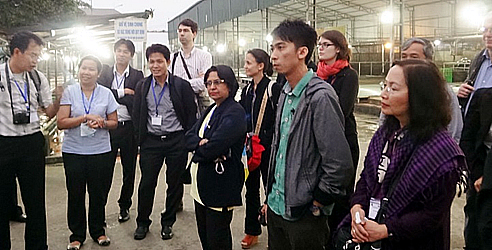 Participants included professors and researchers from universities and government agencies in six Southeast Asian countries and Hong Kong, mostly in veterinary medicine and animal sciences; CIRAD coordinators, project officers, and researchers representing various disciplines including social sciences, natural sciences, and transdisciplinary research; and representatives of regional or country offices of international organizations.
One presentation deemed of interest to SEARCA by the meeting organizers is on an international Master of Science program titled InterRisk: Assessment and Management of Health Risks at the Human, Animal and Ecosystem Interface. It will be offered jointly by Kasetsart University in Bangkok, Thailand, the Institut National Polytechnique de Toulouse in France, and the French International Center in Agricultural Research for Development (CIRAD) starting September 2014. The degree program presents a good model for developing similarly holistic, interdisciplinary degree programs in agriculture/food security. It promotes community-based participatory actions and innovative active learning approaches through real case problem-solving, field visits, computer-based modules, internships, student interaction with professionals from the private agricultural sector, international organizations, governmental agencies, NGOs, and research institutes. Moreover, the program will initiate the creation of professional social networks at a regional level.
Dr. Aurélie Binot, an anthropologist and a geographer with a strong background on multidisciplinary approaches of complex systems where social, political and biological aspects are interrelated, coordinates GREASE Network. Meanwhile, the focal person for the InterRisk Master’s program is Dr. Flavie Goutard of the CIRAD Bangkok Research Unit on Animal and Integrated Risk Management. SEARCA’s participant in the seminar is Dr. Maria Celeste H. Cadiz, Progam Head, Knowledge Management Department.
For more information about the event click here. (Maria Celeste H. Cadiz)
- Date TBA:
No
- Date Format:
Complete date
Two Indonesian nationals presented their research results during a special Agriculture and Development Seminar Series (ADSS) on 28 April 2011. They are Dr. Panji Deoranto and Dr. Masyhuri, who both have ties with SEARCA.
Dr. Deoranto was a SEARCA Scholar, who just received his Ph.D. in Agricultural Economics from the University of the Philippines Los Baños (UPLB) last month. On the other hand, Dr. Masyhuri is the Gadjah Mada University’s Consortium Director for the Southeast Asian University Consortium for Graduate Education in Agriculture and Natural Resources (UC), a network of institutions initiated by SEARCA in 1989. The latter also has a Ph.D. in Agricultural Economics from UPLB.
Dr. Deoranto, who is also a lecturer from the Department of Agricultural Industrial Technology in Brawijaya University, presented his Ph.D. dissertation on the Spatial Integration and Price Transmission of Chicken Markets in Central Java, Indonesia.His study explored the degree of market integration among three market levels: farm, wholesale, and retail. He said that if markets are well integrated, the market players can decide and change commodity prices based on the changes in their neighbor markets. With this, farmers, wholesalers, and retailers can prepare when to produce or sell more. He concluded that improving the integration of chicken markets can boost Indonesia’s chicken production and revive its chicken export.
The second presenter, Dr. Masyhuri, is the Director of the Center for World Trade Studies and a professor of Agribusiness and Agricultural Economics at Gadjah Mada University. His discussion on Food Security in Indonesiahighlighted data on the production and utilization of agricultural products like rice, cereals, and wheat. He explained that food security involves the availability of sufficient quantities of food, accessibility to appropriate and nutritious diet, and the affordability of food products to all households.
He concluded that Indonesia is still food insecure despite high rates of production, importation, and consumption. This is because of the great disparity in the accessibility and affordability of food products in different parts of the country, especially between the urban and rural areas. To attain food security, he stressed that the government should stabilize food prices for consumers and provide consumption subsidies for the poor.
Finally, both speakers stressed out that proper policy and production support by the government is needed to improve market trading and food security in Indonesia. (Peter Jerome B. Del Rosario, Andre Joseph S. de Belen and Regine Joy P. Evangelista)
DISCLAIMER:
The point of view taken by this article is entirely that of the presenter's and does not reflect in any way, SEARCA’s position.
{jcomments on}
- Date TBA:
No
- Date Format:
Complete date
The FISH-BE model has shown that regulated fishing through Marine Protected Area (MPA) Networks could increase fish catch – while improving the state of the marine ecosystem in key areas in the country.
This simulated study from the FISH-BE model means that regulated fishing could help feed the poor and hungry population in the long run, better than the current practice of overfishing. Other studies have also shown that 50% of marine areas need to be protected and regulated to counter the effects of years of overfishing, fishing malpractices, and other factors like climate change.
“This would seem to be an impossible task”, said Dr. Porfirio Aliño of the Marine Science Institute of the University of the Philippines Diliman, during his ADSS presentation on 15 February 2011. He later added that in terms of fisheries management, the cost of doing nothing is much greater.
Dr. Aliño furthered that MPA’s should be implemented in the context of a network or networks of MPAs, working together to achieve a goal. As example, he cited the practice of regulating the efforts of a network of fishing municipalities under a joint alliance within a bay.
His presentation, titled Integrating Marine Biodiversity Conservation Strategies with the Ecosystem Approach to Fisheries Management, also highlighted the current initiatives towards protecting the marine environment, like the Coral Triangle Initiative (CTI) and the different tools available for improving marine ecosystems management, including decision support systems (DSS) tools.
The Coral Triangle Initiative was formed through the partnership of six countries in the coral triangle area, namely: Indonesia, Malaysia, Papua New Guinea, the Philippines, the Solomon Islands, and Timor-Leste. The countries committed themselves to proactively implementing measures to protect the area’s resources for future generations. The CTI’s goals include: managing priority seascapes, applying the ecosystems approach to fisheries management, establishing and effectively managing MPAs, applying climate change adaptation measures, and improving the status of threatened species.
According to Dr. Aliño, the Philippines is the global center of marine diversity. Found at the apex of the coral triangle, the country is being subjected to the harmful effects of climate change. As a government research and development initiative, and one of the coral triangle region's models for climate change adaptation, a local program called ICE CREAM (Integrated Coastal Enhancement: Coastal Research Evaluation and Adaptive Management) is being implemented by the Department of Science and Technology (DOST). Dr. Aliño serves as the program leader.
Initiatives like CTI and ICE CREAM, coupled with the effective implementation of MPAs, could help improve the resilience of our marine ecosystems and increase biodiversity. This will, in turn, increase fish yield and address food security concerns in the region. (Regine Joy P. Evangelista)
DISCLAIMER:
The point of view taken by this article is entirely that of the presenter's and does not reflect in any way, SEARCA’s position.
{jcomments on}