Innovation Platforms, Rural Advisory Services, and Knowledge Management towards Inclusive and Sustainable Agricultural and Rural Development (ISARD): A Forum-workshop
- Download 3 - Text: Handout
- Download 2 - Text: Handout
- Download 1 - Text: Handout
- Venue: SEARCA, Philippines
- Date TBA: No
- Date Format: Complete date
- Date End: 2016-05-19
- Date Start: 2016-05-17

Background and Rationale
 The Southeast Asian Regional Center for Graduate Study and Research in Agriculture (SEARCA), mandated to strengthen institutional capacities in agricultural and rural development in Southeast Asia through graduate education and institutional development, research and development, and knowledge management, champions inclusive and sustainable agricultural and rural development (ISARD) in Southeast Asia in its Tenth Five-year Plan (10th FYP) from 2014 to 2019. Its current thrust on ISARD aligns with the post-Millennium sustainable development goals of the United Nations aimed at eradicating poverty in all its forms and dimensions, including extreme poverty, as the greatest global challenge of this age – recognizing that poverty is predominantly an agricultural and rural phenomenon.
ISARD presupposes that research findings and new knowledge should be used to solve real problems rooted in poverty, hunger, and unemployment that bear upon people. Given the advances in agricultural and rural development (ARD) research, solutions abound and call for smart approaches that connect relevant science, systems, sectors, and governance to the heart of the issues facing ARD communities.
One of SEARCA’s initiatives in advancing ISARD is its centerpiece Piloting and Upscaling of Effective ISARD Models/ Agricultural Systems in Southeast Asia, with the establishment of the project in two pilot sites in the Philippines in 2015. The project capitalizes on strong links with institutional partners in academe, government, civil society, and the private sector. It will showcase need-based and integrated interventions including productivity-enhancing and environment-friendly technologies and practices and other critical elements of people-centered development.
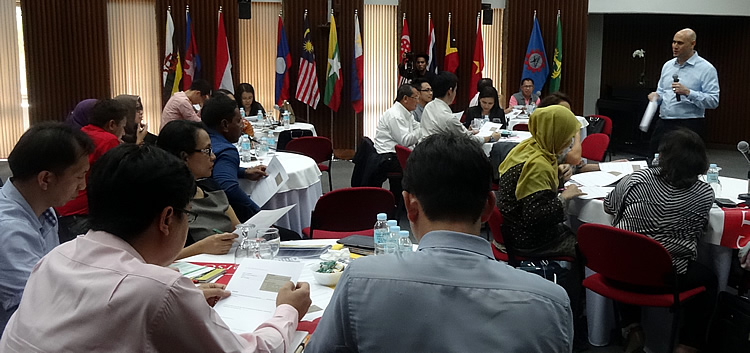
A three-day forum-workshop is proposed to enable focal persons in this project, together with other key ARD actors in Southeast Asia, to draw insights from emerging practices in innovation platforms (IP), rural advisory services (RAS), and knowledge management (KM) toward ISARD. It is hoped that the forum-workshop would distill fresh approaches to inform and add value not just to SEARCA’s ISARD pilot projects, but also to national and local ARD programs in Southeast Asian countries to be represented in the event.
Participants
Prospective participants of this forum-workshop will include key ISARD pilot project team representatives, research and extension managers and leaders, and KM and communication managers in ministries of agriculture, agriculture universities, civil society, and local governments in Southeast Asia.
Limited support will be made available for selected participants from the Philippines who are leading SEARCA ISARD pilot projects; and for nominated participants from Cambodia, Lao PDR, Myanmar, Vietnam, and Timor Leste. Other participants from other Southeast Asian countries and outside the region will be welcome to participate on a cost-sharing arrangement with their own sponsors.
Objectives
The forum-workshop aims to enable participants to:
- Assess how innovation platforms, rural advisory services, and knowledge management provide pathways toward ISARD;
- Strategically integrate innovation platforms, improved rural advisory services, and knowledge management in their R&D programs and projects in agricultural and rural development; and
- Draw up next steps and requirements for capacity-building, pilot-testing/practice learning, and networking to advance ISARD in Southeast Asia via innovation platforms, rural advisory services, and knowledge management.
Scope of the Forum-workshop
Agricultural innovation system and ISARD in Southeast Asia. The forum-workshop will open with an update on the state of agricultural innovation systems in Southeast Asia based on a study by the Organization for Economic Cooperation and Development (OECD) and SEARCA that was completed in 2015. Applying the concept to agricultural development, the World Bank defines innovation systems as “the network of organizations, enterprises, and individuals focused on bringing new products, new processes, and new forms of organization into economic use, together with the institutions and policies that affect the system’s behavior and performance. Innovation systems help to create knowledge, provide access to knowledge, share knowledge, and foster learning. The innovation systems concept embraces not only the science suppliers but the totality and interaction of actors involved in innovation. In other words, the concept extends beyond the creation of knowledge to encompass the factors affecting demand for and use of knowledge in novel and useful ways” (World Bank 2006b cited in Rajalahati et al., 2008).
Innovation Platforms. Partners from the International Livestock Research Institute (ILRI) and/or the CGIAR Research Program on Integrated Systems for the Humid Tropics (Humidtropics R4D) will then present the premises and introduce mechanics of Innovation Platforms (IP) as anchored on experiences of the CGIAR and their national and local partners in developing countries, most especially those appropriate for Southeast Asia.
Across the CGIAR and beyond, there is a recognition that the solution to many agricultural problems lies not in simple technology transfer but in the collective intelligence and effort of multiple stakeholders including, among others, farmers, traders, researchers, financial organizations, and policy makers. Various names have been given to these partnerships and the approach of working together to find innovative solutions. Examples include learning alliances, multi-stakeholder and self-help groups, social learning and social differentiation approaches, and innovation platforms. Significant learning has occurred about what leads such partnerships to generate innovative, cost-effective and sustainable transformations. This learning can be found in formats ranging from academic articles, to videos, to learning materials used in a rich variety of face-to-face training programs.
The ILRI-led sessions will draw on the instructional design services of ILRI’s Capacity Development Unit and the knowledge and experience of subject matter experts (SMEs) from ILRI, IITA, ICRAF and Wageningen University to sequence content and learning experiences so that learners can rapidly acquire and retain the skills and knowledge needed to effectively facilitate innovation platforms. The sessions are based on an online/blended learning course on this topic (http://learning.ilri.org/course/detail/24) and the workshop design is based on a constructivist approach which recognizes that learning occurs as the result of interacting with the content and with other learners.
Rural advisory services. A representative of the Global Forum on Rural Advisory Services (GFRAS) will then discuss the perspective and best practices of modern rural advisory services (RAS) in developing countries. GFRAS defines RAS, also called extension, as “all the different activities that provide the information and services needed and demanded by farmers and other actors in rural settings to assist them in developing their own technical, organizational, and management skills and practices so as to improve their livelihoods and well-being.” GFRAS qualifies that RAS needs to be demand-driven and pluralistic (e.g., multisectoral).
Knowledge management. Participants will then learn about and discuss a case on knowledge management (KM) applied in a national program in agricultural and rural development, then a regional KM initiative that promoted social learning from the community to regional inter-institutional level.
Workshops. Discussions will be anchored on cases and experiences toward a synthesis of important lessons and recommendations for ways forward, including capacity development, policy advocacy, and research and development. Participants may draw insights applicable to their specific programs and institutions, as well as for national and regional agricultural and rural development programs in general.
Forum-workshop Agenda
| TIME |
DAY 1 |
DAY 2 |
DAY 3 |
| 8:30-9:00 | Opening Program | Recap of Previous Day | |
| 9:00-9:30 | Orientation, Expectations Check, Unfreezing |
Workshop: Integrating Innovation Platforms in participants’ R&D programs/ projects (facilitated work in small groups) |
Adding Value to R&D toward ISARD via Knowledge Management* |
| 9:30-10:30 | Agricultural Innovation Systems in Southeast Asia and ISARD | ||
| 10:30-10:45 | COFFEE/TEA | ||
| 10:45-12:15 |
Context, Rationale, and Concept of Innovation Platforms* (ILRI/Humidtropics Modules 1-3) |
Workshop (cont’d) (facilitated work in small groups – and presentations back in plenary) |
Adding Value… (cont’d) |
| 12:15-1:45 | LUNCH | ||
| 1:45-3:15 | Composition, Initiation, Coordination and Facilitation of the Innovation Platform* (ILRI/Humidtropics Modules 4-5) | Rural Advisory Services: Fresh Approaches to Agricultural Extension* | Workshop |
| 3:15-3:30 | COFFEE/TEA | ||
| 3:30-4:30 | Power and Conflict, Communication, and Monitoring and Evaluation* (ILRI/Humidtropics Modules 8,9,13) | Workshop: Review of Rural Advisory Program | Synthesis and Evaluation |
| 4:30-5:00 | Closing | ||
| 5:00-5:15 | Assignments and Announcements | ||
*Note: Case/experience-based presentation of concepts and principles
Partners
SEARCA is organizing the forum-workshop in cooperation with:
- International Livestock Research Institute (ILRI)
- Asia Pacific Island Network for Rural Advisory Services (APIRAS) under the Global Forum on Rural Advisory Services (GFRAS)
Forum-workshop Duration and Venue
17-19 May 2016 | SEARCA, College, Los Baños, Laguna, Philippines
Forum-workshop Fee
- The forum--workshop fee is US$452.00 per participant, which covers forum-workshop materials, meals during the duration of the event, accommodation (twin-sharing), and airport transfers. Live-out rate is US$295.00. Subsidized rates are available upon request to government employees.
- All other expenses associated with the forum-workshop (international air travel, visa, airport terminal fees, travel/health insurance, and other personal expenses) are at the participants’ own expense.
NOTE: Limited training support is open only to qualified nationals of SEAMEO member countries (i.e., Brunei Darussalam, Cambodia, Indonesia, Lao PDR, Malaysia, Myanmar, Philippines, Singapore, Thailand, Timor-Leste, and Vietnam).
Applications
The deadline for filing of application with limited training support is 22 April 2016. Once awarded, grantees will have until 29 April 2016 to officially register for the forum. Deadline for filing of application for fee-paying participants is 29 April 2016. Course fees must be received by SEARCA before the forum-workshop commences. Deadline for registration of fee-paying participants is 9 May 2016.
For the application form for fee-paying participants, please click here.
For training grant applicants, please click on the application form and nomination form.
Additional Information