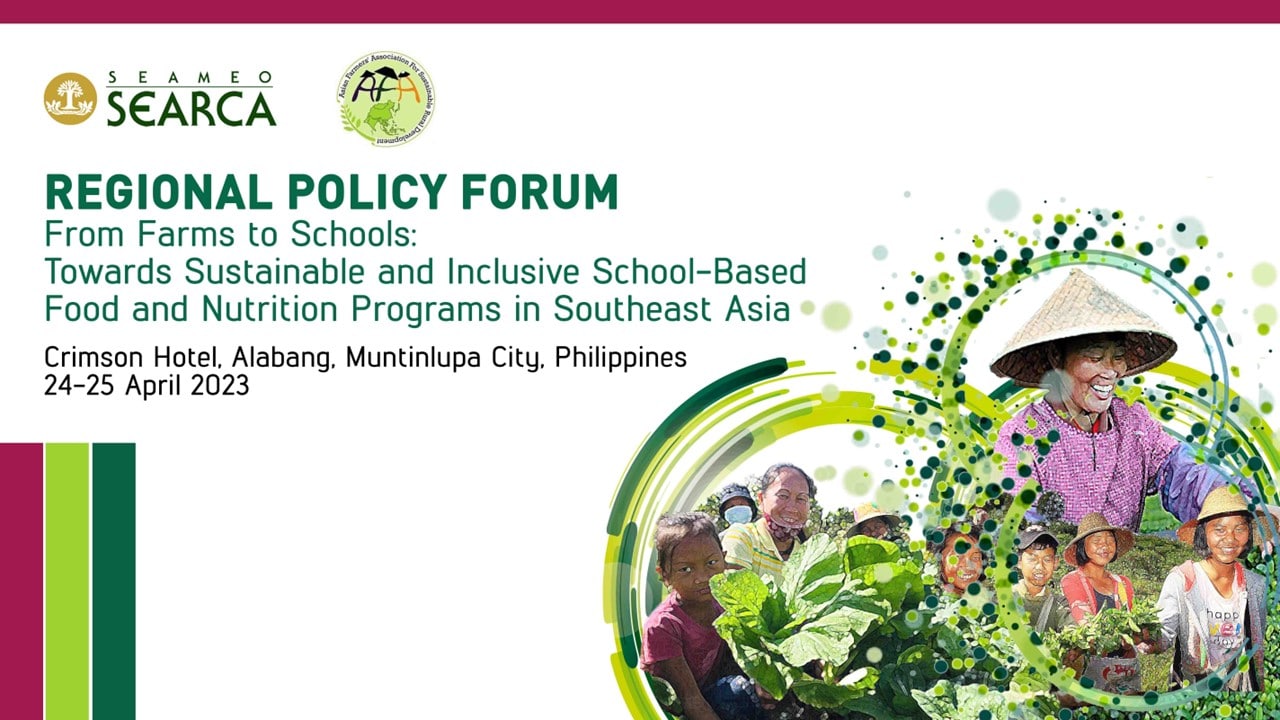
Regional Policy Forum: From Farms to Schools: Towards Sustainable and Inclusive School-Based Food and Nutrition Programs in Southeast Asia
- Download 3 - Text: Handout
- Download 2 - Text: Handout
- Download 1 - Text: Handout
- Venue: Crimson Hotel, Alabang, Muntinlupa City, Philippines
- Date TBA: No
- Date Format: Complete date
- Date End: 2023-04-25
- Date Start: 2023-04-24
Contents
Background and Rationale
State of Food and Nutrition Security in Southeast Asia
Everyone has the right to nutritious, safe, and affordable food. Children who are well-nourished grow and develop to their full potential, while adults become healthier, more productive, and capable. This, coupled with quality nutrition care, brings about benefits that can be carried across generations. Good nutrition can develop prosperous families, fuel a productive workforce, and drive powerful economies (ASEAN, 2022).
Poor nutrition, on the other hand, can result to devastating and often lifelong consequences. Aside from threats to survival, children can suffer from delayed cognitive and motor development, eventually resulting to poor academic and work capacity, reproduction, and overall health. These, in turn, could hinder economic development and contribute to the intergenerational cycle of malnutrition (ASEAN, 2022).
Yet despite such detrimental effects of poor nutrition, countries across Southeast Asia continue to suffer from all forms of malnutrition – undernutrition, micronutrient deficiencies, overweight an obesity, and their associated non-communicable diseases (NDCs), threatening both national social and economic well-being. Recent regional estimates for malnutrition indicated slow progress for the ASEAN Member States (AMS) in terms of meeting its 2025 global nutrition targets. A significant number of children starts life at a disadvantage, suffering from moderate to high rates of stunting, wasting, and overweight in most of the member states (ASEAN, 2022).
As a response to all these, governments across the region are doubling their efforts to adopt policies and programs aimed at improving nutrition across the lifecycle. These policies and programs foster an enabling environment for nutrition and strive to maintain healthy diets and lifestyles even during emergencies and shocks. One focus in the region is improving nutrition in school-aged children. Member states are linking nutrition and education by using schools as a platform to prevent and treat malnutrition in children and adolescents through micronutrient supplementation, physical education, school feeding programs, and school gardens (ASEAN, 2022).
However, to sustain such activities, there is a need to foster an enabling policy environment that would support their continued implementation. Moreover, there is also a need to continuously innovate and evolve the programs and find ways of making them sustainable and inclusive.
Family Farming and the UN Decade of Family Farming (2019-2028)
Family farming is considered as the backbone of global agriculture. It produces 80% of the world's food (in value) making it the most predominant form of food and agricultural production. Family farmers are also seen as key agents of development. Despite being mainly reliant on family labor, family farms carry the pressure of feeding a growing population and ensuring food security and are vital to eradicating poverty, undernourishment, and malnutrition. They also serve environmental, social, and cultural functions, such as protecting the natural environment and biodiversity and maintaining community and cultural heritage (FAO and IFAD 2019).
In December 2017, the United Nations proclaimed 2019-2028 as the Decade of Family Farming (UNDFF) primarily aiming to achieve positive change in the global food systems. The implementation of the UNDFF is guided by its Global Action Plan (GAP) which is hinged on seven (7) pillars. One of the pillars, Pillar 5, focuses on improving the socio-economic inclusion, resilience, and wellbeing of family farmers, rural households, and communities. Included in its intended outcomes is the improvement of family farmers' access to markets and diversified income sources. Engagement in institutional procurement programmes and procedures, such as for food assistance and school feeding could facilitate partnerships between family farmers and schools providing them with guaranteed, continuous, and structured demand for their products and services (FAO and IFAD 2019).
Addressing the Nutrition-Education-Development Nexus through Farm-to-School Programs
One initiative that has been gaining significant attention and has been proven successful in developing countries around the world is farm-to-school programs. A Farm-to-School Program (F2SP) "enriches the connection communities have with fresh, healthy food and local food producers by enhancing food purchasing and education practices at schools and early care and education sites" (farmtoschool.org). With the inclusion of farms, early care, and education, F2SPs can empower children and their families to make informed food choices while strengthening the local economy and contributing to vibrant communities (farmtoschool.org).
The implementation of F2SPs also addresses the triple nexus of nutrition, education, and development by: (1) Providing all kids access to nutritious, high-quality, local food so they are ready to learn and grow; (2) Enhancing classroom education through hands-on learning related to food, health, agriculture, and nutrition; and (3). Serving as a significant financial opportunity for farmers, fishers, ranchers, food processors, and food manufacturers by opening doors to an institutional market worth billions of dollars. F2SPs also benefit everyone by providing opportunities to build family and community engagement. The purchase of food items from local producers and processors for school feeding programs creates new jobs and strengthens the local economy (farmtoschool.org).
For a region whose agriculture sector is mainly composed of small-scale family farmers, F2SPs present them with a valuable opportunity for added income and livelihood by creating new markets for local farms. These new markets allow farms to connect with institutions, such as schools, and establish partnerships. These are well-aligned with the intended outcome of the UNDFF Pillar 5. F2S activities also offer important social benefits by increasing the visibility of farms and drawing attention to their positive contributions to community and environmental health. Moreover, F2S activities also create venue for social interactions which can enhance community cohesion (foodcommunitybenefit.noharm.org).
Recognizing the opportunities and potential solutions presented by F2SPs in addressing the food and nutrition security issues in the region, SEARCA, in partnership with the Asian Farmers Association for Sustainable Rural Development (AFA), will organize a regional policy forum to discuss how the existing school-based food and nutrition programs in the region could be further enhanced or strengthened and made more sustainable and inclusive through the involvement and participation of family farmers.
Objectives
The forum generally aims to discuss potential policy interventions and courses of action to address the nutrition-education-development nexus through the inclusion of family farmers in new and/or existing school-based food and nutrition programs in Southeast Asia.
Specifically, the forum will:
- Provide an overview of current state of food and nutrition security in Southeast Asia;
- Present ongoing school-based food and nutrition programs being implemented in the region;
- Identify and analyze opportunities and challenges in adopting and/or strengthening farm-to-school models for school-based food and nutrition programs in the region; and
- Develop policy recommendations, identify courses of action, and explore potential areas for collaboration to engage family farmers in school-based food and nutrition programs to ensure their sustainability and inclusiveness.
Expected Outputs
As a result of the forum, the following outputs are expected to be developed:
- A general framework for developing new and/or enhanced school-based food and nutrition programs;
- A detailed documentation of the event (Proceedings Report); and
- A policy paper discussing the recommendations gathered from the event.
Expected Outcome
Through the forum, participating organizations will be encouraged to development and implement sustainable and inclusive school-based and food nutrition programs backed by strong policies and programs by their respective governments. Possible partnerships and collaborative activities toward addressing food and nutrition security issues in the region through school-based food and nutrition programs are also expected to be explored.
Target Participants and Resource Persons
The forum targets to gather representatives from the following:
- Ministries of education and agriculture in Southeast Asia
- International/development organizations
- Academic institutions
- Farmers' and civil society organizations
Program
Masters of Ceremonies:
Ms. Carmen Nyhria Rogel and Mr. Jerome Cayton Barradas